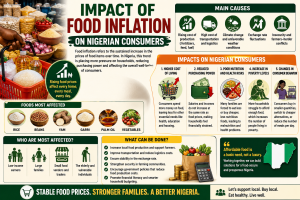
IMPACT OF FOOD INFLATION ON NIGERIAN CONSUMERS
Nigeria’s inflation has genuinely come down from its 2024 peak, headline inflation peaked at approximately 34.80% in late 2024 and has been declining since. But by May 2026, the annual inflation rose for a third straight month to 15.93% , marking the highest since last November .
Many Nigerians are are still paying historically high amounts for basic items . Food is where the pain concentrates and its been especially volatile in 2026. Food inflation was 8.89% in January 2026 , briefly suggesting a dramatic slowdown , then reversed sharply climbing to 12.12% in February , 14.31% in March and 16.06% in April.
By May 2026 it accelerated further to 17.8% , alongside transport rising to 17.1% , partly driven by the pass-through of a March fuel price shock linked to the middle East conflict. In April 2026, food inflation exceeded inflation for the first time in eight months and remained above 20% in Eleven states , highest in Enugu at 32.7% , Kwara at 30.8% and Adamawa at 30.1%.
What that means at the market , as at April 2026, a 50kg bag of rice sells for about #61,000 , frozen chicken costs roughly #6000 per kilogram , a paint of garri is around #1900 and yam goes for #3900 per medium tuber.
WHY FOOD KEEPS BEING UNSTABLE
- Insecurity in major food-producing regions has displaced farmers , reduced cultivated land , disrupted supply chains and increased cost of moving produce , keeping food prices higher as headline inflation eases.
- High transport costs mean goods moving from rural farmland to urban markets stay expensive, and roadblocks and extortion on transport corridors add hidden costs to final prices.
CONCLUSION
Food inflation continues to outpace headline inflation and weaken household purchasing power , and as one sustainability researcher put it , the accumulated damage to household purchasing power isn’t repaired just because pace of new price increases slow down . Even a return to single-digit inflation wouldn’t undo the compounding effect of last 2-3 years , the price level itself remains far above where it was before the 2023-2025 policies .