
Consumer Protection for the Elderly, Youth and Rural Dwellers
Every Nigerian is a consumer, but not every consumer is equally protected. Age, experience, location and access to information decide who gets cheated and who gets justice. The elderly, young people and rural dwellers are three groups that suffer exploitation most often and speak up least.
The Elderly: Trust Used Against Them
Older consumers often grew up in a time when a seller’s word was enough. Fraudsters know this and exploit it.
Common problems
- Phone and transfer scams, including calls from people posing as bank staff or relatives in trouble
- Fake health products and “miracle” remedies, especially for blood pressure, diabetes and joint pain
- Unauthorized debits from pension and savings accounts
- Pressure to sign documents they cannot read clearly or fully understand
- Difficulty with digital banking, which leaves them dependent on strangers at ATMs and POS points
How to protect them
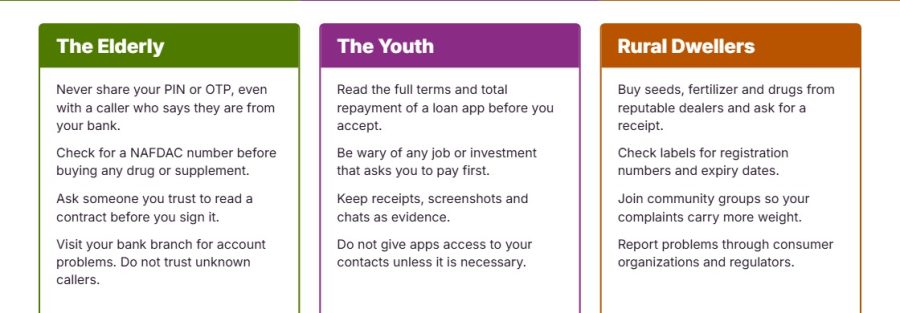
- Never share your PIN, OTP or card details with anyone, including someone who says they work for the bank.
- Check that any drug or supplement carries a NAFDAC registration number before buying.
- Ask a trusted family member to read any contract before it is signed.
- Visit the bank branch in person for any account issue instead of trusting a caller.
- Families should check in regularly on older relatives’ accounts and purchases.
The Youth: Eager, Online and Targeted
Young Nigerians are active online and open to new opportunities, and that makes them targets.
Common problems
- Digital loan apps with hidden charges, extreme interest and harassment of contacts
- Fake job offers and “investment” schemes that demand upfront fees
- Online sellers who take payment and disappear
- Betting and quick-money platforms that hide the real odds
- Subscriptions and data charges that quietly drain airtime and accounts
How to protect yourself
- Read the full loan terms, including total repayment, before you accept. A genuine offer will not hide its cost.
- Be suspicious of any job or investment that asks you to pay first.
- Use payment methods that leave a record, and keep screenshots, receipts and chats.
- Check a seller’s reviews and history, and pay on delivery where possible.
- Do not give apps access to your contacts and gallery unless it is necessary.
Rural Dwellers: Far From Help
Consumers in villages and small towns face a different challenge, which is distance. Regulators, courts and consumer groups seem far away, and many people do not know a complaint can be made at all.
Common problems
- Fake, expired or substandard goods sold in local markets, including fertilizers, seeds, drugs and household items
- Overpricing because buyers have few alternatives
- Wrong weights and measures at markets
- Estimated electricity bills and unresolved meter problems
- Poor network service that makes it hard to report anything
- Low awareness of consumer rights and complaint channels
What can help
- Buy inputs such as seeds, fertilizers and agrochemicals from reputable dealers, and always ask for a receipt.
- Check labels for registration numbers and expiry dates.
- Form or join community and cooperative groups so that complaints carry more weight.
- Use local leaders, community associations and consumer organizations to pass complaints on to regulators.
What Everyone Should Know
Whatever your age or location, the same basic rights apply. Under the Federal Competition and Consumer Protection Act, you have the right to accurate information, to safe goods and services, and to fair treatment. When something goes wrong:
- Keep evidence: receipts, messages, photos, account statements.
- Complain to the business first, in writing if you can.
- Escalate to the right regulator if there is no response, such as the FCCPC for general consumer complaints, the CBN for banking matters, the NCC for telecoms, NERC for electricity and NAFDAC for food and drugs.
- Seek support from a consumer protection organization if you need help.
Building a Protected Community
Laws help only when people know about them and use them. That means:
- Young people can teach parents and grandparents how to spot scams and use banking apps safely.
- Elders can pass on experience about patience and verification, and warn youth against get-rich-quick traps.
- Communities can share information about dishonest sellers and push for the services they pay for.
Consumer protection works best when people protect each other. A cheated elder, a scammed student and a defrauded farmer all have the same right to be heard, and the first step is knowing that the right exists.
Conclusion
Consumer protection is not a privilege for the educated, the young or the city-based. It is a right that belongs to every Nigerian, whether a retired teacher guarding her pension, a student dodging a loan app, or a farmer buying fertilizer in a village market.
The elderly need protection from those who exploit their trust. Young people need the knowledge to spot traps before they fall into them. Rural dwellers need a voice that reaches beyond their communities. All three groups need the same things: information, evidence, and someone willing to listen when they complain.
Each of us has a part to play. Check on an older relative. Teach a younger one to read the fine print. Share what you know with your community. And when you are wronged, speak up. Every complaint made helps another consumer avoid the same problem.
Together, we can build a Nigeria where no consumer is ignored because of their age or where they live.
Save the Consumers Initiative of Nigeria
Phone: 07032150324, 08052205072
Website: www.savetheconsumers.org